Tandir Orthopedic Implants Tandir Orthopedic Implants

7 Best MRI Safe Orthopedic Implants Are They Safe?

Time:2026-10-18 Author:Oliver
0%

Are orthopedic implants safe for MRI? The honest answer is more careful than a simple yes or no. Many modern orthopedic implants use titanium, cobalt-chromium, stainless steel, or specialized polymers. Their behavior depends on material, shape, fixation, scanner strength, and imaging conditions.

Frank G. Shellock, PhD, a recognized MRI-safety researcher, states: “MR Conditional means safe only under specified conditions.” That sentence deserves attention. “Only under specified conditions.” A hip replacement may remain stable during a 1.5-tesla scan, yet require different limits at 3 tesla. Heating, magnetic force, torque, and image distortion can still matter.

The American College of Radiology’s 2024 Manual on MR Safety recommends structured screening, implant identification, and verification of labeling before scanning. The FDA’s MRI device guidance also emphasizes testing for displacement force, torque, heating, and artifact. ASTM F2503 provides the widely used framework for MR Safe, MR Conditional, and MR Unsafe labels.

Real-world experience exposes the weak point: implant records may be incomplete. A patient may remember “metal in my knee,” but not the manufacturer or model. That uncertainty cannot be solved by guessing. It requires operative notes, device databases, radiographs, or manufacturer confirmation.

This guide examines seven widely used MRI-compatible or MR Conditional orthopedic implant categories. It considers safety evidence, practical scanning limits, and everyday clinical questions. Some claims remain imperfect. “MRI safe” is not a universal promise. It is a conditional decision, made for one patient, one implant, and one scanner at a time.
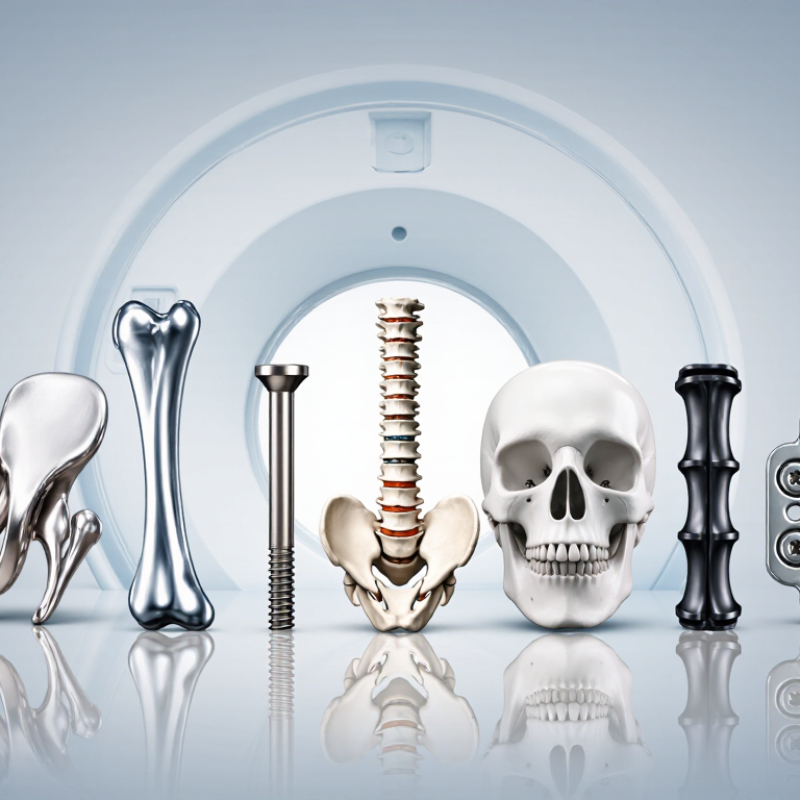
7 Best MRI Safe Orthopedic Implants Are They Safe?

MRI Safety Labels: MR Safe, MR Conditional, and MR Unsafe Under ASTM F2503

Orthopedic implants are often described as MRI safe, but that phrase can mislead. Under ASTM F2503, MR Safe means no known hazards in any MR environment. MR Conditional means the device has been tested only under stated conditions, such as field strength, scan time, or SAR. MR Unsafe means it can create unacceptable risks and should not enter the MRI environment. These labels apply to the specific implant, not every plate, screw, hip, knee, spinal cage, nail, or fixation anchor.

The seven common implant groups may include joint replacements, bone plates, screws, spinal cages, intramedullary nails, fixation rods, and soft-tissue anchors.

However, “best” is not universal. Material, design, implant location, and documentation all matter.

A conditional implant may heat, move, or create image distortion when scanning rules are ignored. A small marker near the knee can still affect nearby images. The scan room team should verify the exact model and conditions before imaging.

Tips: Bring the implant card, operative report, or radiology record. Do not rely on memory alone. Ask about the approved field strength and specific absorption rate. Confirm whether the label covers the complete implant system. If records are incomplete, pause and request expert review. Labels reduce uncertainty, but they do not replace careful screening.

Seven Implant Types Compared by MRI Heating, Force, and Artifact Risk

7 Best MRI Safe Orthopedic Implants: Are They Safe?

Orthopedic implants behave differently inside an MRI scanner. Titanium plates and screws usually create low heating and moderate artifacts. Stainless steel may produce stronger image distortion, especially near the spine or joint. Cobalt-chrome components can resist magnetic force, but their dense structure may obscure nearby tissue. Nitinol devices often show limited movement risk, yet heating depends on shape and scan settings.

Tantalum implants are generally stable, though their high density can create noticeable artifacts. Ceramic components produce minimal magnetic interaction and often preserve clearer images. Carbon-fiber reinforced polymer implants usually cause the least distortion, but their fixation hardware may still affect safety. No implant is automatically safe in every scanner. The exact model, position, implant age, and MRI sequence matter. That detail is easy to overlook.

Tips: Bring implant records whenever possible. Tell the MRI team about every metal device, even an old one. Ask whether the implant is MR Conditional and confirm its field-strength limits. Heating may feel like a deep, focused warmth. Report discomfort immediately. Never rely on the word “titanium” alone; mixed materials and nearby screws can change the risk. A careful assessment may still be imperfect when records are missing.

7 Best MRI-Safe Orthopedic Implants: Are They Safe?

Relative comparison of typical MRI heating, magnetic force/torque, and image-artifact risk by implant type. Scores range from 1 = lower relative risk to 5 = higher relative risk.

These are generalized material-level ratings based on established MRI safety principles. Most passive orthopedic implants are MR Conditional or MR Safe under specified conditions, but the exact implant model, MRI field strength, scan settings, and manufacturer labeling must always be verified before scanning.

Titanium and PEEK Implants: MRI Performance at 1.5T and 3T

Titanium and PEEK implants usually perform well during MRI, but “MRI safe” is an incomplete description. ASTM F2503 recommends “MR Conditional” when safety depends on field strength, scan time, or implant configuration. The ACR Manual on MR Safety also requires screening for implant materials, fixation systems, and unknown components.

At 1.5T, titanium orthopedic implants generally create manageable susceptibility artifacts. At 3T, those artifacts can become more noticeable, especially near joints and spinal canals. Published MRI studies report greater image distortion around titanium than around PEEK. PEEK has very low magnetic susceptibility, so it often produces cleaner images. That matters when clinicians inspect nerves, cartilage, or small fractures. Less distortion helps.

Heating remains a separate concern. ASTM F2182 testing evaluates radiofrequency heating under controlled conditions, not every real-world scan. Implant shape, screws, conductive loops, and positioning can change results. A 2023 FDA MRI guidance document stresses testing the complete device system, rather than judging one material alone. That is easy to overlook. Titanium may be mechanically excellent, yet its artifact can obscure anatomy. PEEK may reduce artifacts, but it can require radiopaque markers for visibility. Published evidence is useful, not absolute. Always verify the implant’s current conditions at 1.5T or 3T, including specific absorption rate limits and scan duration.

FDA Guidance on SAR Limits, Gradient Exposure, and Implant Conditions

7 Best MRI Safe Orthopedic Implants: Are They Safe?

FDA guidance makes MRI safety more specific than a simple “safe” label. Most orthopedic implants are described as MR Conditional, meaning they are acceptable only under stated conditions. These conditions may include scanner strength, such as 1.5T or 3T, maximum SAR, gradient limits, scan duration, and patient positioning. Radiofrequency energy can heat metal components. Changing gradients may also cause stimulation, vibration, or device movement.

Implant conditions matter. The radiology team should review the implant record, surgical date, fixation method, and current symptoms before scanning. Some implants require special positioning or restricted operating modes. Hardware near sensitive anatomy may need extra attention, even when its material appears nonmagnetic. The word “safe” is too absolute. Real safety depends on the complete system: patient, implant, scanner, and trained staff.

Tips: Bring the implant card or operative report. Confirm the exact model and conditions. Do not rely on memory. Tell staff about pain, swelling, warmth, or unusual sensations. Technologists should monitor the patient and stop the scan if discomfort develops. A written clearance can reduce confusion, but it cannot replace the manufacturer’s approved instructions or clinical judgment. Evidence is strong for many common implants, yet unusual combinations and incomplete records still require caution. Mistakes often begin with missing details.

7 Best MRI-Safe Orthopedic Implant Categories: Are They Safe? FDA Guidance on SAR Limits, Gradient Exposure, and Implant Conditions
Implant Category Common Non-Brand Materials Typical MRI Safety Status Primary MRI Safety Concerns Important Conditions to Verify Practical Safety Assessment
Titanium bone plates and screws Titanium or titanium alloy; some systems use radiolucent polymer components. Usually MR Conditional Potential radiofrequency heating, image artifact, and small magnetic or gradient-induced forces depending on geometry and fixation. Field strength, whole-body SAR or B1+rms limit, scan duration, operating mode, implant location, and manufacturer-tested configuration. Generally among the more MRI-compatible fixation options, but the exact implant and labeling must still be confirmed before scanning.
Stainless-steel orthopedic fixation Medical-grade austenitic stainless steel, commonly used in selected screws, plates, wires, and fixation devices. Usually MR Conditional Greater susceptibility artifact than titanium in many applications; heating and displacement risk depend on alloy, shape, and fixation. Exact alloy, passive or active implant status, field strength, SAR limit, spatial-gradient limit, and device-specific scanning instructions. Often scannable when securely implanted and properly labeled; do not assume all stainless-steel devices behave identically.
Cobalt-chromium joint replacement components Cobalt-chromium-molybdenum alloy, frequently used for load-bearing arthroplasty components. Usually MR Conditional Local susceptibility artifact may reduce diagnostic quality; radiofrequency heating is normally evaluated for the complete implant configuration. Implant model and size, field strength, SAR or B1+rms restriction, scan mode, and any special positioning requirements. Fixed, passive joint components are commonly eligible for MRI under specified conditions, but the implant record remains essential.
Ceramic hip or knee components Alumina, zirconia-toughened alumina, or other medical ceramics, usually combined with metal or polymer parts. Usually MR Conditional Ceramic itself is generally nonconductive and nonferromagnetic, but the complete assembly may include conductive metal components that affect heating and artifact. Complete implant composition, field strength, SAR or B1+rms limit, implant configuration, and local safety policy. Often produces less susceptibility artifact than some metal components, but “ceramic” alone does not establish MRI safety.
PEEK spinal cages and fixation systems Polyether ether ketone, often combined with titanium markers, screws, rods, or plates. Usually MR Conditional PEEK is nonmetallic, but associated metal hardware may cause artifact, heating, or induced-current concerns. Whether metallic markers or fixation are present, field strength, SAR or B1+rms limit, scan duration, and the full construct configuration. Can be favorable for postoperative imaging, especially when metal content is limited; the entire spinal construct must be evaluated.
Tantalum orthopedic implants Porous or solid tantalum used in selected bone substitutes, revision components, and structural implants. Usually MR Conditional Potential susceptibility artifact and radiofrequency interaction; safety depends on implant geometry and the tested system. Field strength, spatial-gradient limit, SAR or B1+rms restriction, implant dimensions, and conditions stated in the device labeling. Can be scanned when the specific implant is documented as MR Conditional; material identity alone is not sufficient.
Bioabsorbable orthopedic screws and anchors Polymer-based materials such as polylactic acid, polyglycolic acid, or composite bioabsorbable materials. Often MR Conditional Polymer components generally have low magnetic interaction, but radiopaque markers, metallic inserts, or composite structures may alter MRI conditions. Exact composition, presence of metal markers, implant location, field strength, SAR or B1+rms limit, and time since implantation if specified. Often suitable for MRI under labeled conditions, but the absence of visible metal on an image does not prove that the implant is MR Safe.
FDA and MRI safety note: The FDA generally relies on device-specific MR labeling and recognized test methods rather than one universal SAR limit for every orthopedic implant. MRI personnel should verify the exact implant, its MR safety label, static magnetic field strength, spatial-gradient limit, whole-body or local SAR/B1+rms restriction, scan duration, operating mode, and any positioning requirements before scanning. “MR Conditional” means safe only under specified conditions; “MR Safe” is reserved for items demonstrated to pose no known hazards in all MRI environments.

Pre-Scan Verification: Matching Implant Labels to 1.5T or 3T Protocols

7 Best MRI Safe Orthopedic Implants: Are They Safe?

Pre-scan verification matters more than the phrase “MRI safe.” Most orthopedic implants are classified as MR Conditional, not universally safe. Their conditions may differ at 1.5T and 3T. A small metal plate, spinal screw, or joint replacement can require specific limits for field strength, spatial gradient, SAR, and scan time. The implant label should state these conditions clearly. Do not rely on memory.

Staff should compare the exact implant record with the planned MRI protocol. Check the implant type, location, fixation method, and implantation date. Then confirm whether the scanner operates at 1.5T or 3T. The radiologist and MRI technologist should review heating risks, movement concerns, and image distortion. Nearby metal may create dark bands or blurred anatomy. That can affect diagnosis.

A patient’s operative note is often more useful than a vague card. Yet records can be incomplete. This is where verification becomes difficult. A “titanium” description alone does not prove compatibility. Some systems include mixed materials or special components. When details remain uncertain, pause the scan and seek written information from the surgical facility or qualified implant specialist. Safety decisions should never depend on a guessed model. A missed appointment is frustrating. An avoidable exposure is worse.

FAQS

Are orthopedic implants automatically safe inside an MRI scanner?

No. Safety depends on the implant model, position, age, materials, and scanner settings.

How does titanium usually behave during MRI?

Titanium usually creates limited heating and moderate image distortion.

Does PEEK create clearer MRI images than titanium?

Often, yes. PEEK has very low magnetic susceptibility and usually produces less distortion.

Can an implant become hot during an MRI scan?

Yes, heating can occur under certain scan conditions.

Do stainless steel implants cause MRI image problems?

They may create stronger distortion, particularly near joints or the spine.

Are ceramic implants usually suitable for MRI?

Ceramic components generally interact minimally with magnetic fields.

What should patients tell the MRI team about implants?

Report every implant, including old devices and unknown components.

What does “MR Conditional” mean for an implant?

It means the implant may be scanned only under specified conditions.

Can cobalt-chrome, nitinol, or tantalum implants affect MRI images?

Yes. Cobalt-chrome may obscure nearby tissue because of its dense structure.

Is carbon-fiber reinforced polymer always the best MRI option?

It usually causes very little image distortion.

Conclusion

Are orthopedic implants safe for MRI? In most cases, they can be scanned safely when their materials, design, and approved conditions are carefully verified. Under ASTM F2503, implants are classified as MR Safe, MR Conditional, or MR Unsafe. This article compares seven common orthopedic implant types, including plates, screws, spinal rods, joint replacements, intramedullary nails, fixation anchors, and interbody cages, focusing on MRI-related heating, magnetic force, torque, and image artifacts.

Titanium and PEEK generally demonstrate favorable MRI performance at 1.5T and 3T, although the exact implant design and scanning conditions remain important. FDA guidance emphasizes controlling SAR, gradient exposure, scan duration, and other operating limits to reduce risk. Before scanning, healthcare professionals should confirm the implant’s documentation, match its conditions to the planned 1.5T or 3T protocol, and assess the potential for diagnostic image distortion. A verified implant label and properly managed protocol are essential for safe, informed MRI decisions.

Oliver

Oliver

Oliver is a seasoned marketing professional with a wealth of expertise in driving brand awareness and engagement. With a deep understanding of our company's product offerings, he consistently delivers high-quality content that enriches our professional blog. His insights not only shed light on......